The economics of robot calibration are changing. Here's what that means.
For most of the history of industrial robotics, there's been exactly one way to make a robot more accurate: hire a metrology specialist, rent or buy a laser tracker, shut down the cell, and spend hours — sometimes days — running a calibration procedure that most teams can't do in-house.
Laser trackers work. They measure position with sub-micrometer precision, and for applications that need that level of accuracy — aerospace machining, precision medical device assembly, high-value metrology — the investment makes sense. The parts are worth enough to justify $50,000 to $150,000 in equipment, plus the engineering time to operate it.
But here's what we've learned from talking to dozens of robotics teams: most of them don't need sub-micrometer accuracy. They need their robot to actually go where the controller says it should go. And for that problem, the laser tracker has always been overkill — not because the technology is wrong, but because the cost structure makes it inaccessible to the teams that need calibration the most.
The teams that live with the error
The robotics teams we talk to — cobot OEMs, system integrators, precision manufacturing operations — are building systems where accuracy matters but the unit economics don't support traditional metrology.
A startup building a cobot for lab automation can't justify a $50,000 laser tracker for every unit they ship. An integrator deploying welding cells for a contract manufacturer isn't going to bring in a metrology specialist every time they commission a new robot. A warehouse automation company running hundreds of arms across multiple sites can't shut down production for a full-day calibration on each machine.
So they live with the error. They run slower to hold tolerance. They spend days on touch-up programming to teach each robot where things actually are versus where the kinematic model says they should be. They accept that programs aren't portable between nominally identical cells because each robot has a slightly different error signature.
These aren't teams that don't care about accuracy. They're teams that can't afford the cure.
What changed
The fundamental insight behind our approach to kinematic calibration is that you don't need external metrology equipment to identify a robot's real geometric parameters. You need the robot's own sensors and a known reference.
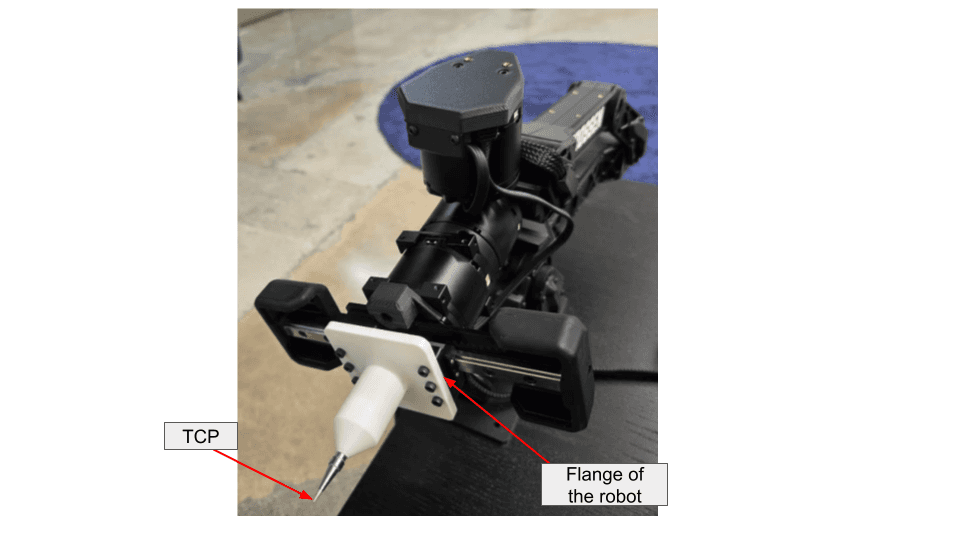
Our calibration process uses a commodity hardware fixture — a precision calibration target that can be built from off-the-shelf components for under $35 and assembled in under five minutes. The robot touches or approaches the target in a structured sequence of configurations, and from the joint encoder data at each configuration, we identify the actual kinematic parameters of the machine. Link lengths, joint axis orientations, offsets, frame alignments — the real values, not the nominal ones from the manufacturer's datasheet.
The calibration takes approximately 10 minutes. No laser tracker. No metrology specialist. No production shutdown beyond the time it takes to run the routine.
The results
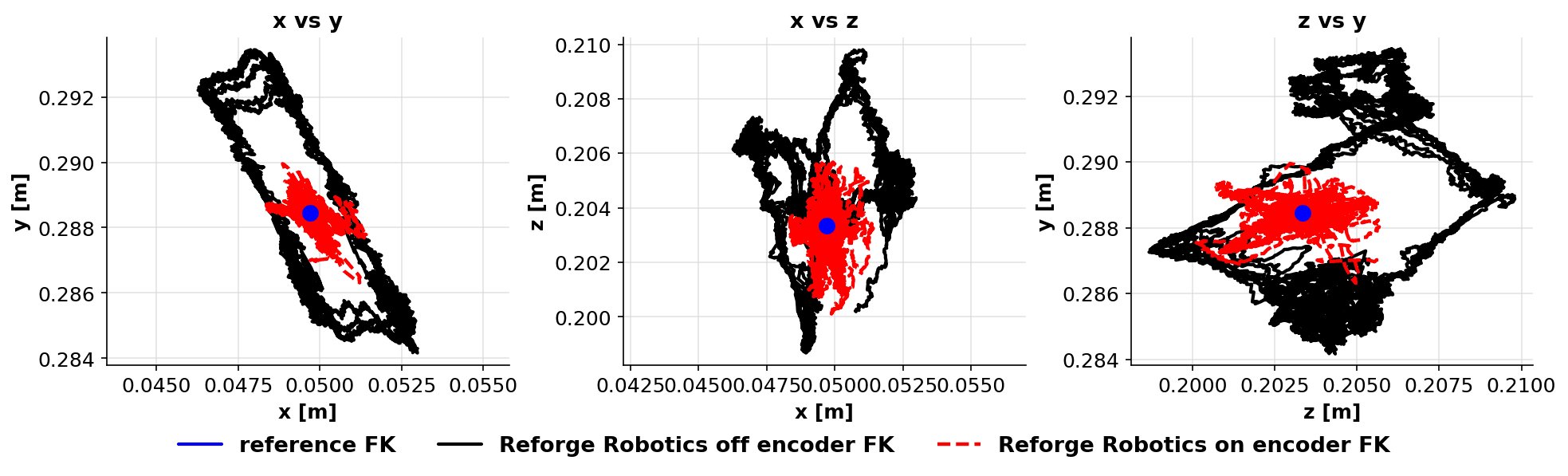
We've validated this approach across multiple robot platforms. The measured improvement: positional accuracy improves from roughly 0.6 to 1.0mm down to 0.18 to 0.21mm. That's a 3x to 5x improvement in absolute accuracy.
To put that in context: a robot with 1mm of positional error needs touch-up programming for almost any precision task. A robot with 0.2mm of positional error can run from offline-generated paths. That's the difference between a cell that takes a week to commission and one that takes a day. Between a program that needs to be re-taught on every robot and one that deploys to the fleet.
The accuracy we achieve isn't laser-tracker-grade. We're not claiming sub-0.1mm performance. For applications that genuinely need that — and some do — traditional metrology is still the right tool. But for the vast majority of robotic applications, getting from 1mm to 0.2mm is the step change that matters. It's the threshold where calibration goes from "nice to have" to "the robot actually works."
The cost comparison
The math is straightforward.
Traditional calibration:
Laser tracker: $50,000 to $150,000 (purchase or rental)
Metrology specialist: typically contracted, hourly or daily rate
Production downtime: hours to a full day per robot
Recalibration frequency: rarely repeated because of cost, even when accuracy drifts
Software-based calibration:
Calibration fixture: under $35 in commodity parts, assembles in under 5 minutes
Specialist required: none — the calibration routine runs through the SDK
Production downtime: approximately 10 minutes
Recalibration frequency: can be repeated after every collision, tool change, maintenance window, or on a regular schedule
The per-robot cost drops by orders of magnitude. But the more important shift is what becomes economically viable when calibration is cheap.
What changes when calibration is affordable
When calibration costs $50,000, you calibrate once and hope the robot doesn't drift. When it costs 10 minutes of downtime, the whole relationship between accuracy and operations changes.
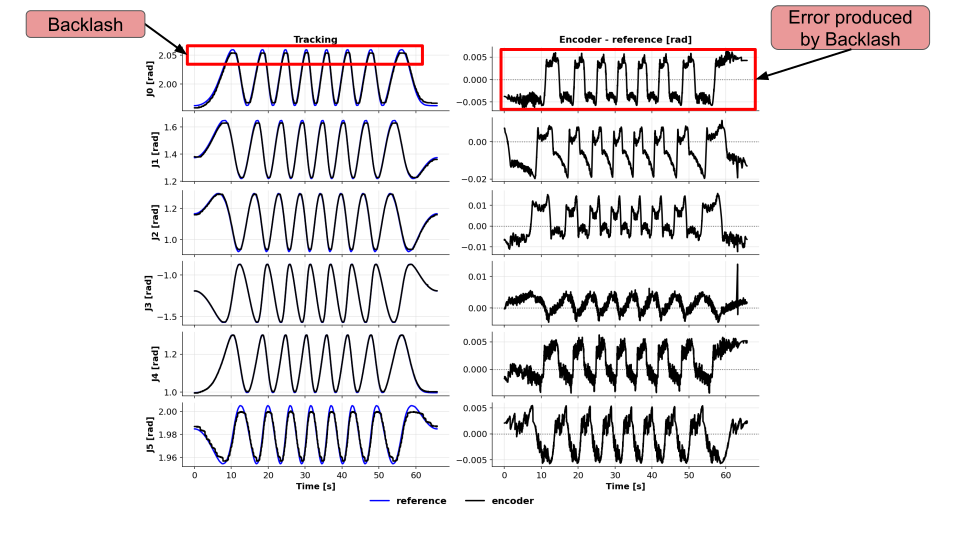
Routine recalibration. Robots drift. Gearbox backlash increases. Bearings develop play. Thermal changes shift the geometry. A collision throws everything off. With affordable calibration, you can recalibrate on a schedule — weekly, monthly, after every maintenance window — the same way you'd change oil in a car. Not because the robot has catastrophically failed, but because maintaining accuracy is now cheaper than living with drift.
Per-unit calibration at scale. If you're an OEM shipping hundreds of robots, per-unit calibration at the end of the manufacturing line becomes a realistic quality step. Every robot ships with a calibrated kinematic model that reflects its actual geometry, not the nominal geometry from the CAD model. The customer receives a robot that goes where it's told from day one.
Fleet-wide accuracy. For operations running multiple robots — across a facility, across sites — affordable calibration means programs become portable. Calibrate each robot to the same standard, and the program that works on one machine works on all of them. The per-robot variation that currently forces per-robot commissioning gets resolved at the calibration step, not the programming step.
Recovery after incidents. Collisions happen. Currently, a collision that changes the robot's geometry means calling in a specialist or living with degraded accuracy until the next scheduled maintenance. With a 10-minute recalibration, you recover immediately. The robot is back to spec before the next shift.
The laser tracker isn't going away
We're not arguing that laser trackers are obsolete. For applications that need sub-0.1mm accuracy — and they exist — precision metrology equipment remains the right tool. For calibrating large-scale structures, multi-robot cells with tight relative positioning requirements, or applications where traceability to metrology standards is a contractual requirement, laser trackers earn their cost.
What we are arguing is that the vast majority of robots running in production today don't need laser-tracker-grade calibration. They need to close the gap between where the controller thinks they are and where they actually are. And for that problem, the economics have fundamentally changed.
The question is no longer "can we afford to calibrate?" It's whether you can afford not to — when the alternative is 10 minutes and $35.
Reforge Robotics builds motion control software that makes robot calibration fast, affordable, and repeatable.

Iago Alves Pereira
Co-Founder & CTO
Share post
Written by
Iago Alves Pereira, Co-Founder & CTO
Published on
Continue Reading



See what Reforge can improve on your robot
Bring one representative trajectory or error dataset. We’ll identify the relevant product, required inputs, and a bounded evaluation plan.

See what Reforge can improve on your robot
Bring one representative trajectory or error dataset. We’ll identify the relevant product, required inputs, and a bounded evaluation plan.