Robotic logistics
Smoother motion at production speed: Dexterity’s truck-loading validation with Reforge
- peak reduction in RMS vibration
- 85%
- picks per hour in production test
- 485
- faster settling time
- 2x

When you’re vibrating a lot, moving a lot unnecessarily, it really slows down the robot’s ability to move quickly. You’re afraid of dropping the package.
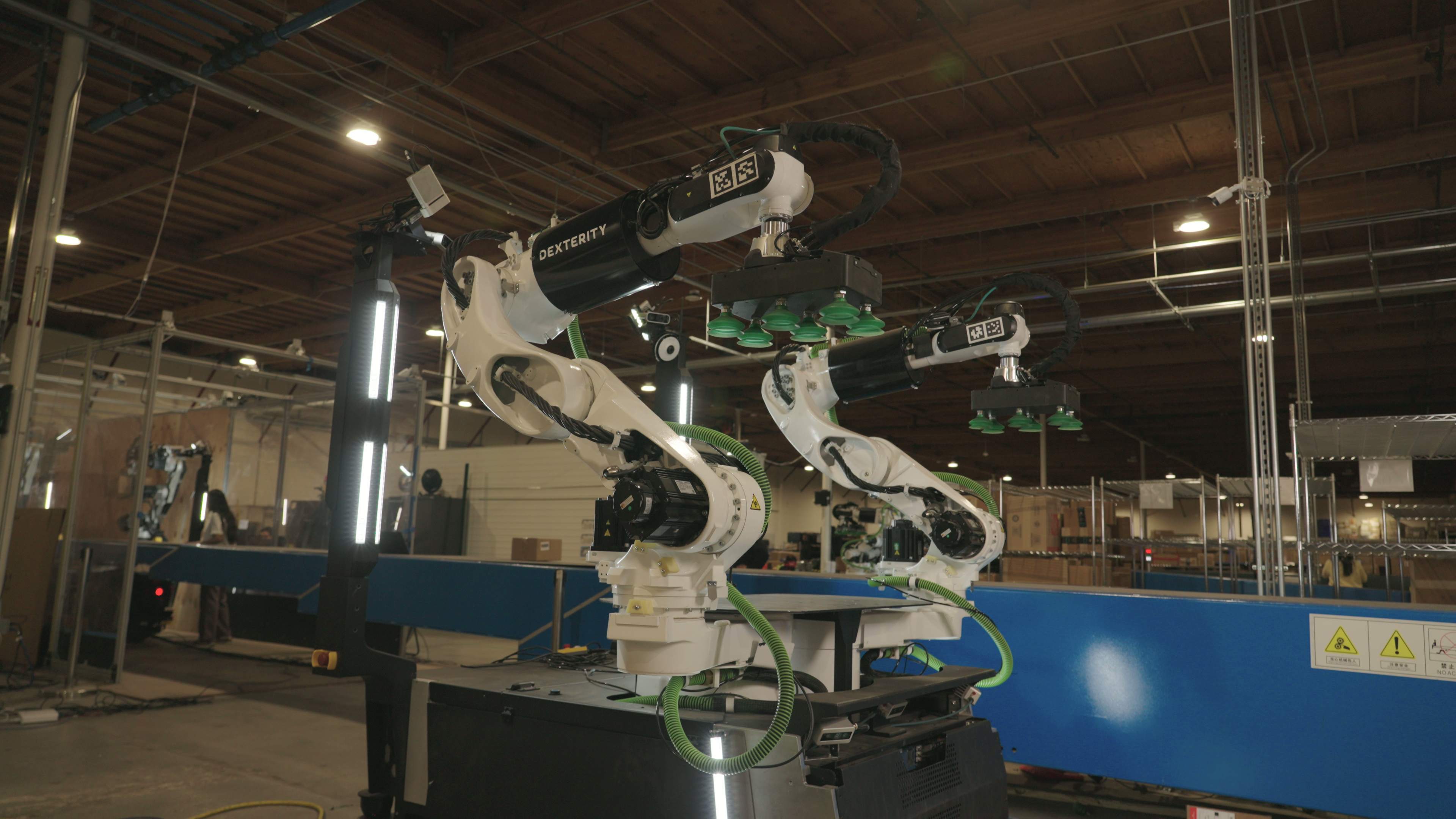
Dexterity worked with Reforge Robotics to characterize the real dynamics of its Mech truck-loading platform, integrate Reforge Shaper into its existing motion pipeline, and reduce unwanted vibration without sacrificing picks per hour.
The challenge: motion quality has to survive production constraints
Dexterity’s truck-loading system uses large, fast robot motions to move freight through a full trailer workspace. The installed system introduces dynamics that an ideal robot model does not capture: flexibilities in the arm and mobile base, changing payload, and installation all influence how the machine moves and settles.
Mech brings two robot arms and onboard compute together in one system. That gives Dexterity a compact platform for work inside a trailer, where the robot needs to move packages and sense its surroundings throughout the loading task.
For Dexterity's customers, the difference between a shaky robot and a robot that moves smoothly can affect their buying decision. The smoother robot can also produce a more stable base-mounted camera feed, helping Dexterity create its next motion plan sooner. In logistics, speed matters, so the joint team sought to reduce vibration across truck-loading motions while preserving picks per hour.
The approach: model the robot as installed, then shape the motion
Reforge Shaper fits into Dexterity’s existing motion workflow after trajectories are generated and before commands reach the robot. Dexterity’s application and planning stack remain responsible for the task; Shaper adjusts the motion using models generated from measurements of the installed robot.
The team measured how the physical robot moved, then used the calibration data to generate robot-specific models for motion shaping. They evaluated the approach in simulation and on the physical system before testing it during truck-loading work.
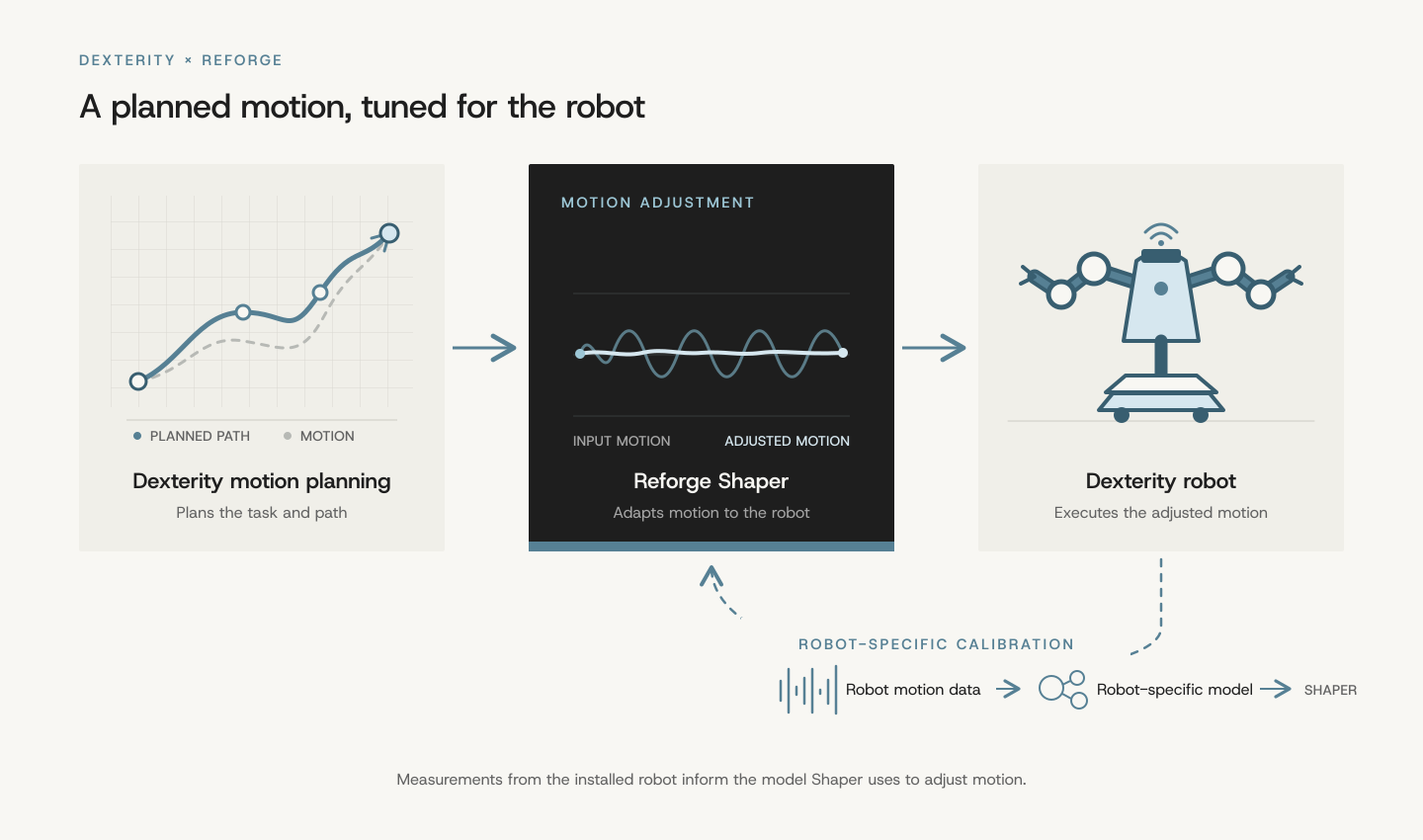
Reforge Shaper fits between Dexterity’s motion planning and the robot.
The team looked at motion quality as part of the broader loading sequence: reducing vibration after one move can help the robot get on with the next task sooner. As one Dexterity speaker explains in the case-study video:
“With Reforge, reducing the vibration on individual motions reduces the buildup of this vibration.”
— Sreenidhi Tupuri, Robotics Software Engineer, Dexterity
What the teams learned during deployment
Moving from a proof of concept to full-system validation exposed the details that determine whether motion software works in production. The mechanical environment affects how a robot moves and settles, so measuring the installed system gives the motion-shaping model a useful picture of the robot it needs to control.
The integration let Dexterity retain its existing task and planning workflow while Reforge Shaper adjusted the robot’s motion.
That recovery between moves matters in a system that also needs to sense and plan around moving freight. A Dexterity speaker describes the practical effect:
“And this allows us to begin the next motion really fast because sensing can happen on a dime. We don’t have to wait for vibration to settle.”
— Robert Sun, Founding Engineer, Dexterity
Results
Dexterity achieved 2x reduction in settling time and up to 85% reduction in vibration while maintaining throughput to 485 PPH.
At the individual-motion level, one production comparison with higher motion limits enabled found pick moves 14% shorter, place moves 12% shorter, with 51% lower median vibration after place moves and 65% lower median vibration after reset moves. These motion-level measurements complement the overall results above.
| Measure | Result |
|---|---|
| Peak reduction in RMS vibration | Up to 85% |
| Throughput | 485 picks per hour in the production test |
| Settling time | Up to 2x faster |
The result shows how improving robot motion can support high-throughput logistics work. For robotics teams more broadly, the deployment illustrates a practical path for improving installed-machine behavior through software: calibrate the robot in its real environment, generate models from measured behavior, and integrate motion optimization without replacing the application stack.
Improve robot motion without redesigning the hardware
Reforge Robotics helps robotics teams calibrate the machine they actually built, generate robot-specific models, and deploy model-based motion control through an open developer workflow.