—And why it's costing you more than you think.
In 2024, we set out to solve a problem that most robotics teams had learned to live with: residual vibration.
Not because it was unsolvable — the physics and control theory have existed for decades. But because solving it required bridging a gap that the robotics industry had quietly accepted. On one side, affordable robot hardware that's proliferating across every sector. On the other, motion performance that still depends on manual tuning, conservative speed limits, and a lot of patience.
Residual vibration sits right in that gap. And it's more expensive than most teams realize.
The problem hiding in plain sight
Every robotics engineer has seen it. The arm reaches the target position, and instead of stopping cleanly, it shakes. Sometimes for a few milliseconds. Sometimes long enough to watch.
What's actually happening is straightforward physics. A robot arm is not a perfectly rigid machine. It has structural compliance, actuator dynamics, cable routing, and real-world properties that the commanded trajectory doesn't account for. When the joints reach the target, the rest of the system hasn't fully settled. Energy is still stored in the structure. The end-effector oscillates around the intended position until that energy dissipates.
That oscillation is residual vibration. And it doesn't just show up at the end of moves — the robot is lagging, overshooting, and ringing at structural frequencies throughout the entire trajectory. The controller just doesn't know it.
The real cost
We've worked with teams across truck loading, precision manufacturing, and visual inspection. The pattern is always the same: vibration quietly constrains three things that directly affect the business.
The cost of vibration and Reforge Robotics' solution to it
Throughput. Every move that ends with vibration needs settling time before the next operation can begin. In a single pick-and-place cycle, that might be 50 to 200 milliseconds. Across thousands of cycles per shift, that settling time becomes hours of lost output. For high-volume applications, we're talking about a measurable hit to unit economics.
Accuracy. If the application can't wait for the vibration to settle — because the next operation starts immediately, or the arm is in continuous motion — the robot is executing at a position offset from where the controller thinks it is. In welding, dispensing, inspection, or any path-sensitive task, this degrades quality.
Deployment time. This is the one that surprises teams the most. Vibration behavior changes with speed, payload, mounting, and even the specific robot unit. A trajectory that works cleanly on one machine may vibrate badly on another. One software manager at a robotics company told us their engineers would "perpetually spend 5% of engineering time fine-tuning control speeds for different applications." Multiply that across every deployment, and you have a serious engineering bottleneck.
Why robots vibrate
Residual vibration is not a defect. It's physics.
Every robot arm is a mechanical system with mass, stiffness, and damping at every link and joint. When the robot accelerates or decelerates, those physical properties determine how the structure responds. If the commanded motion includes acceleration changes that excite the system's natural frequencies, the structure will vibrate.
Think of it like a spring-mass-damper system — the fundamental model we use in mechanical engineering. The robot's links have mass and resist acceleration (inertia). The structure resists deformation like a spring (stiffness). And energy dissipates through joint friction and material behavior (damping). The equation of motion that governs this — mx'' + cx' + kx = F(t) — is well understood. The challenge is that every robot, in every installation, has different values for those parameters.
Three factors make this especially pronounced on modern cost-effective robots:
Lighter, more flexible structures. Affordable arms use lighter materials and less rigid construction. That lowers the natural frequencies of the system, which means even moderate speeds can excite vibration. Heavier industrial robots aren't immune — they just push the problem to higher speeds.
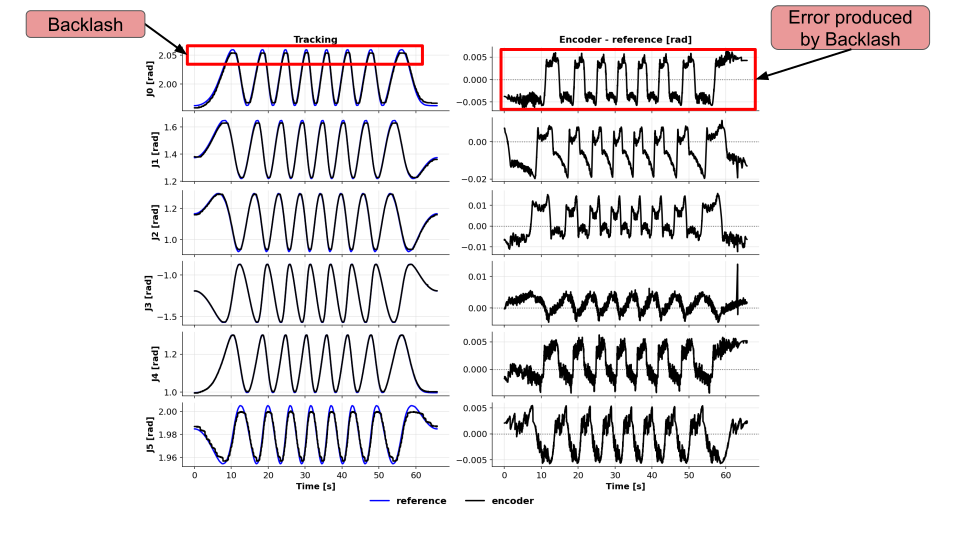
Lower-resolution actuators. Less expensive motors and gearboxes have more compliance, and less precise torque control. What the joint actually delivers is a noisier version of what was commanded.
Generic controller tuning. Most robot controllers ship with a single set of gains optimized for a general case. They don't account for the specific payload, mounting structure, or installation. Every deployment starts with a controller that is only approximately correct for the system it's controlling.
Why common fixes fall short
The instinctive response is to slow the robot down. Lower speeds mean lower accelerations, less energy into structural modes, less vibration. It works — but it trades throughput for smoothness. At some point, the business case for automation breaks down.
The next step is manual gain tuning. An engineer adjusts controller parameters — PID gains, acceleration limits, jerk limits — until the vibration is acceptable for a specific trajectory and payload. This works for a fixed scenario. Change the speed, change the payload, move the robot to a different mounting, and you're back to tuning.
The common thread: these approaches are either too conservative, too narrow, or too labor-intensive to scale.
Closing the gap with data from the real machine
The fundamental problem is that the controller doesn't know enough about the physical system it's controlling. It commands a trajectory based on an idealized model — or no model at all — and the real dynamics create the gap that shows up as vibration.
We solve this by calibrating the robot as installed — on its real structure, with its real payloads, using its real actuators — and changing the model with the system's configuration and payload. During calibration, sensors capture the machine's physical responses while controlled excitations expose its resonant frequencies and structural behavior. From that data, we build a precise and comprehensive dynamic model — a mathematical replica of how that specific robot actually moves, bends, and vibrates.
That model deploys directly into the control architecture. The software anticipates and neutralizes physical deviations before they happen. No manual gain tuning. No conservative speed limits. No months of trial and error.
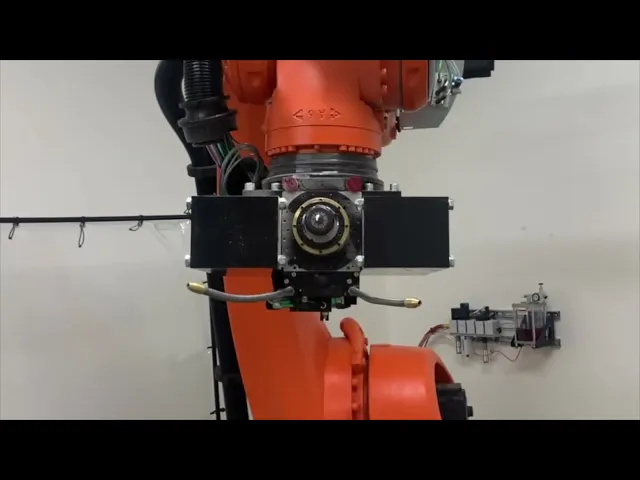
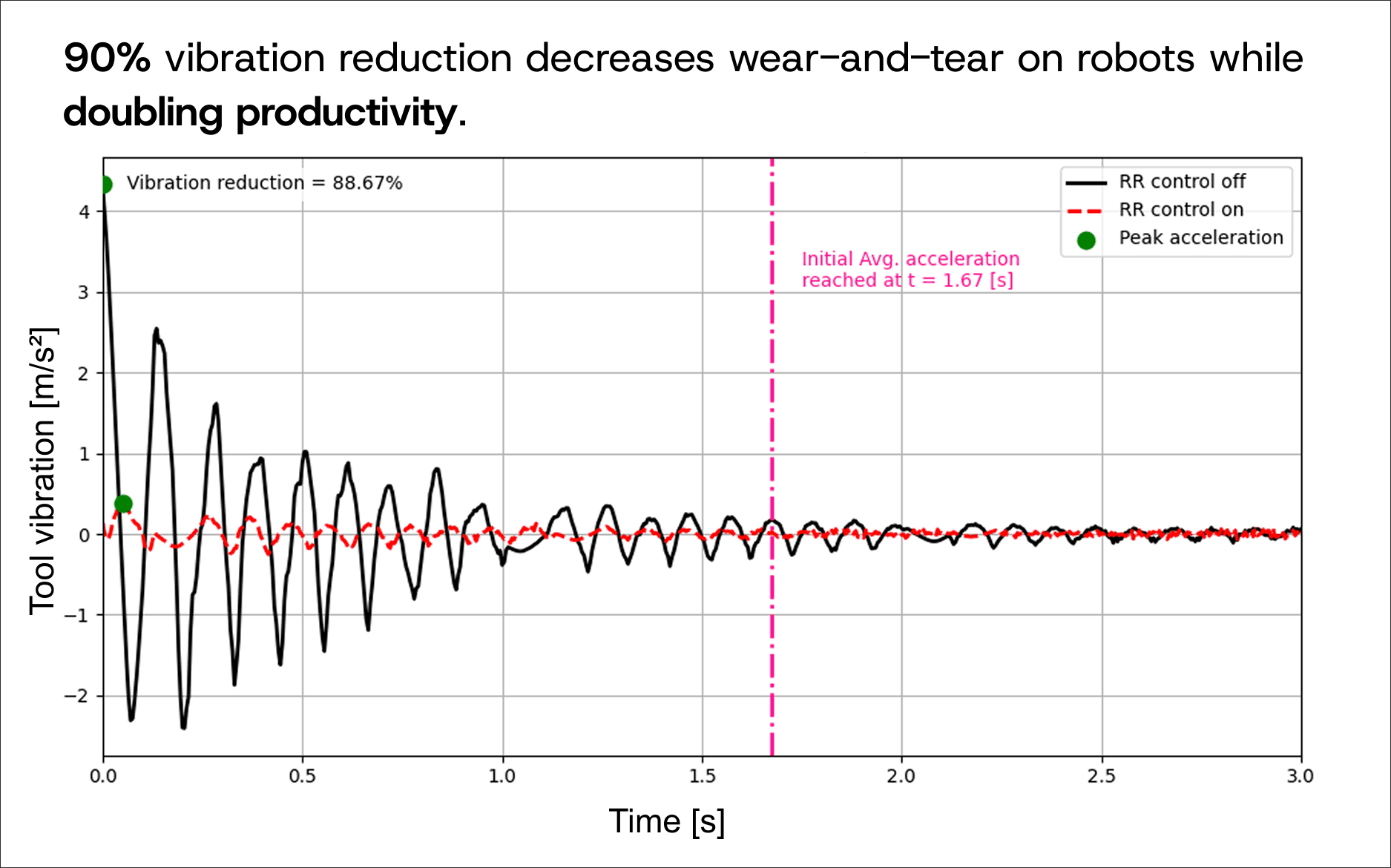
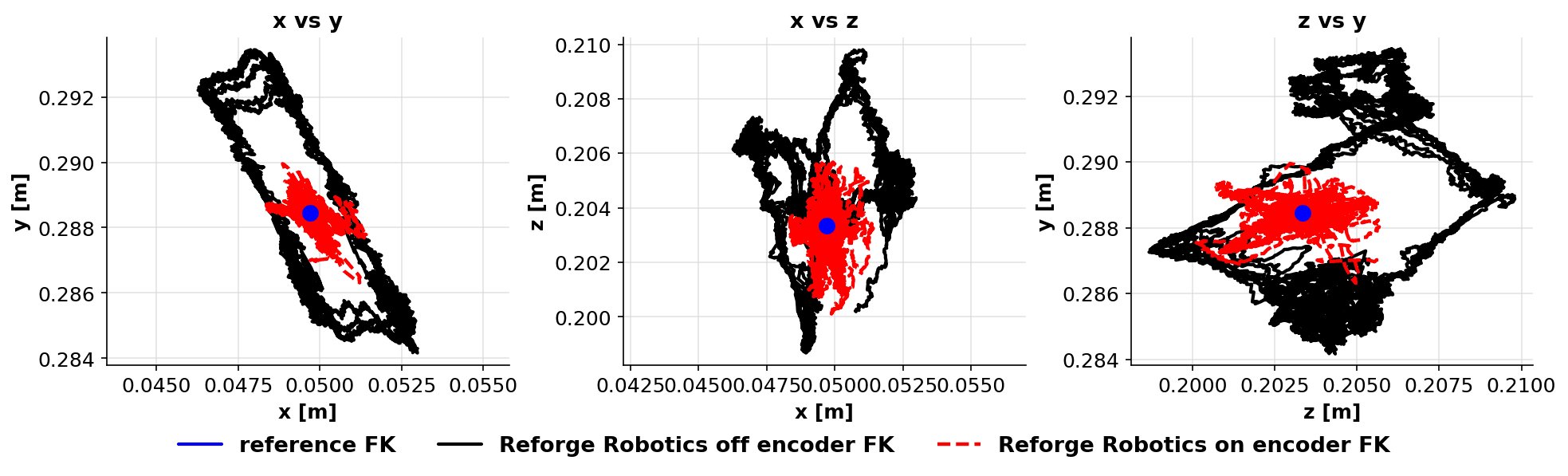
Here's what that looks like in practice on a KUKA KR500:
The results speak for themselves: we've demonstrated larger than 85% reduction in vibration even with a 2x increase in productivity. The machine gets faster and smoother at the same time — through software alone, with zero hardware modifications.
The best part is we've built production infrastructure around it. You start with a base model that you fine-tune to your setup. Our databases store and maintain models for each robot in your fleet. And we provide enterprise-grade support as you scale.
Why this matters now
Cost-effective robots are proliferating across the general-purpose robotics market. They're cheaper, easier to deploy, and increasingly paired with AI systems that can plan, perceive, and adapt.
But intelligence doesn't eliminate motion error. A robot still has to follow the path. It still has to move quickly without shaking. It still has to repeat the same motion reliably. It still has to behave in production the way it behaved in testing.
The industry has largely solved the design and mass manufacturing of affordable robots. What it hasn't solved is making those robots perform like high-end machines. That's a software problem — and it's the one we're working on.
The robot vibrates because the controller doesn't know how the real machine moves. Fix that, and the robot stops shaking.
Reforge Robotics builds open-source motion control software that helps robots move faster, track more accurately, and behave more predictably.
Contact us to learn more about how we address residual vibration.

Nosa Edoimioya
Founder & CEO
Share post
Written by
Nosa Edoimioya, Founder & CEO
Published on
Continue Reading


See what Reforge can improve on your robot
Bring one representative trajectory or error dataset. We’ll identify the relevant product, required inputs, and a bounded evaluation plan.

See what Reforge can improve on your robot
Bring one representative trajectory or error dataset. We’ll identify the relevant product, required inputs, and a bounded evaluation plan.